By Nikia Gray and Danielle Taylor
NALP Bulletin+, May 2026
View this article as a PDF
On June 29, 2023, the Supreme Court of the United States issued a historic decision ending race-conscious admissions programs at colleges and universities across the country. The ruling reversed decades of precedent and forced many institutions to revisit their admissions policies. It also prompted widespread concern among educators and professional organizations — including NALP — that the decision could further entrench racial inequality in education and in the professions that depend on those pipelines.
In many respects, however, the legal profession has already experienced the effects of similar policy changes on a smaller scale. For decades, a number of states have maintained bans on race-conscious admissions in public universities. These policies provide an opportunity to study how such bans affect not only law school enrollment, but also the employment outcomes of law school graduates.
Recent research has begun to quantify the effects of those policies. In a first-of-its-kind study, law professors Kyle Rozema, Richard Brooks, and Sarath Sanga examined the impact of state-level affirmative action bans since 1980 on law school enrollment. Their findings were striking — racial diversity at public law schools declined by as much as 20 percent following the implementation of these bans, with the most selective schools experiencing declines of up to 35 percent. As the authors emphasized, “law schools present uniquely high stakes,” because they serve as pipelines to leadership roles in government and private industry. Lawyers comprise roughly a tenth of CEOs, a third of state governors, more than a third of U.S. House members, more than half of U.S. senators, and nearly all judges and prosecutors. Through this lens, shrinking racial diversity in law schools has implications that extend far beyond the academy.
Focusing solely on admissions, however, may underestimate the magnitude of the impact on the legal profession. NALP’s research has long documented persistent disparities in employment outcomes by race and ethnicity. Graduates of color consistently experience lower rates of employment — both overall and within jobs requiring bar admission. Black, Native, and Indigenous graduates are also significantly underrepresented in private practice, while graduates of color more broadly are underrepresented in federal clerkships, both of which often serve as gateways to the highest-paying and some of the most influential roles in the profession.
The causes of these disparities are complex. One longstanding concern, however, has been the strong preference for certain law school pedigrees prevalent among larger law firms and federal courts. If the Supreme Court’s decision not only reduces racial diversity overall but shifts where racially diverse graduates enroll in law school, then the downstream effects on employment outcomes in these two sectors specifically could be substantial.
To better understand these dynamics, NALP recently engaged Professor Kyle Rozema as a research consultant to collaborate on a series of projects examining the impact of state-level affirmative action bans on the racial diversity of entry-level jobs across the legal industry. By studying the states that already had implemented such bans, we hope to provide the profession with a clearer picture of what the post-affirmative action landscape may look like and what steps might mitigate its effects.
Our first project focuses on two distinct segments of the legal job market: federal judicial clerkships and top-paying law firm positions. Using NALP’s historical Employment Report and Salary Survey data, we defined these law firm positions as those paying at least the 25th percentile of prevailing BigLaw salaries in a given year. We refer to these roles collectively as highly remunerative “pipeline positions,” reflecting both their substantial early career pay advantage and their long-term influence on professional trajectories. Although we recognize the importance of broad diversity in every segment of the legal industry, we chose to start our investigation with this inquiry because of the high likelihood that the bans amplified the existing disparities NALP has documented in these segments. Additionally, these positions are notable as they are highly sought after by graduates. They are also among the most economically consequential. The median starting salary at the largest law firms is typically 2.5 to 3 times that at the smallest firms and public service employers, and the earnings gap widens with seniority. Because of this differential, early access to these roles can have significant long-term implications for earnings and career advancement.
Our analysis examined how affirmative action bans affected the employment outcomes of graduates from underrepresented minority (URM) groups — defined as graduates identifying as Black or African American, Latinx, Multiracial, Native American, Alaska Native, Native Hawaiian, or other Pacific Islander. Asian graduates were not included in the URM definition because they have historically had the highest rate of entry into private practice of any cohort tracked by NALP, typically entering law firms at rates five to eight percentage points higher than the class overall.
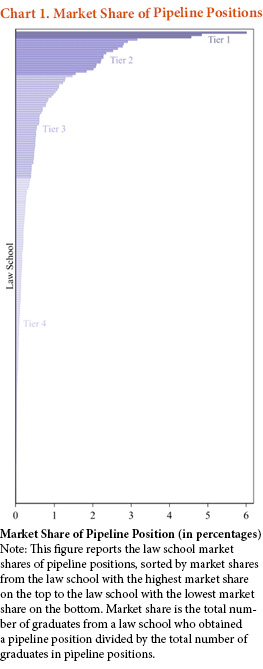
Before analyzing the effects of the bans themselves, we first examined how strongly a law school pedigree shapes access to pipeline positions. Looking at the market share of these positions by law school, we found striking levels of concentration. Nineteen law schools — producing only 16 percent of annual law school graduates — filled 53 percent of all pipeline positions, more than the combined market share of the remaining 186 law schools.
Against this backdrop of concentrated hiring, the effects of affirmative action bans are pronounced. Among the schools that account for this high concentration and that were subject to a ban, the number of URM graduates obtaining pipeline positions declined by 68 percent after the bans were enacted. The effects were not as great at schools outside this group, but they are still quite large, with the number of URM graduates obtaining pipeline positions from those schools having declined by 41 percent after the bans were enacted.
Breaking down the decline at the schools that account for the high concentration, roughly two-thirds of the decrease was attributed to reduced enrollment of URM students at those schools, while the remaining third reflected a decline in the rate at which those graduates obtained pipeline positions. The opposite was true for schools outside this group, where the majority of the decrease was attributed to a decrease in the placement rate of URM graduates in pipeline positions, largely owing to the enrollment of URM students continuing to cascade to less selective schools, and thus to schools that place fewer students in pipeline positions.
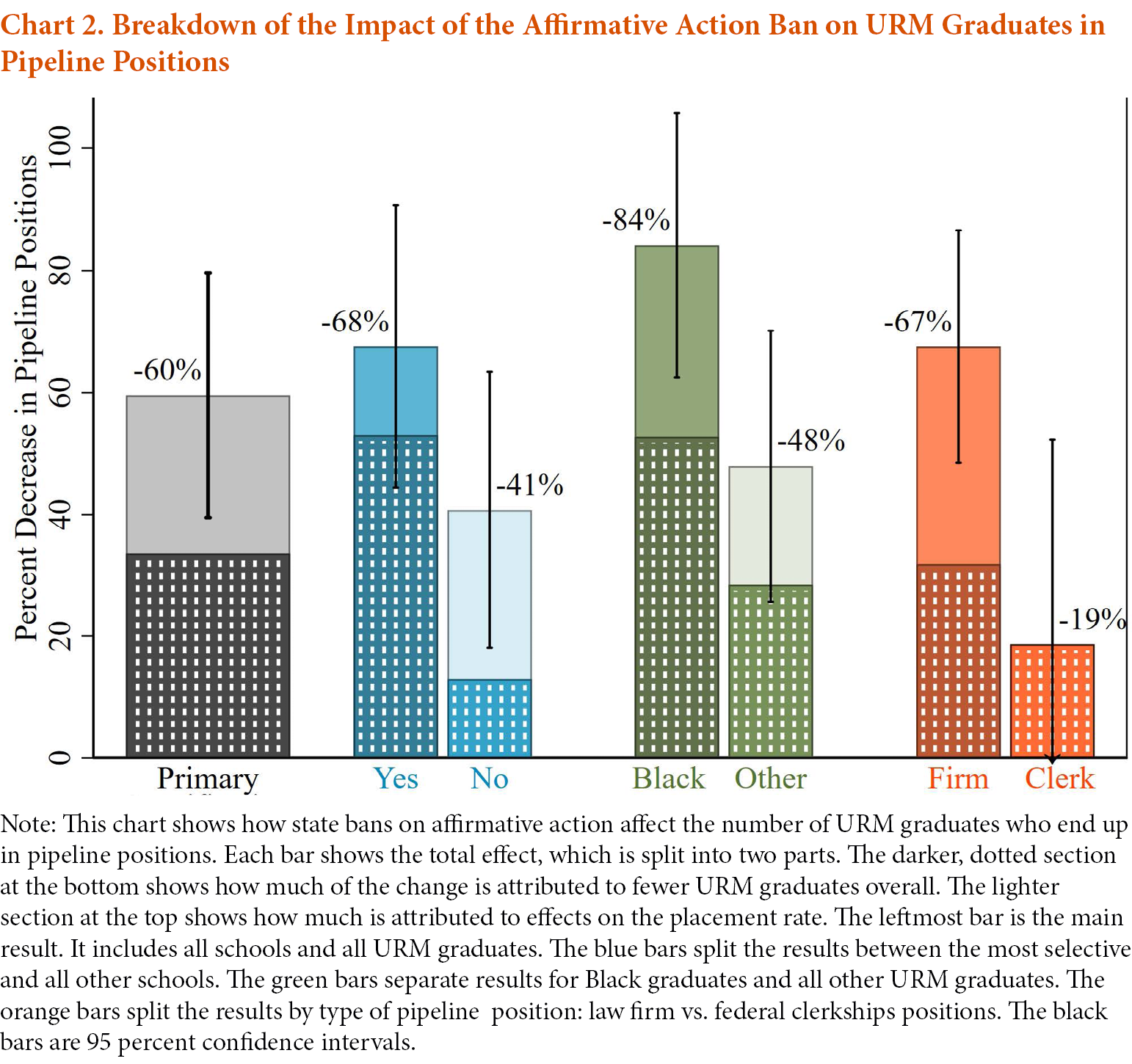
The impacts were particularly severe for Black graduates. The number of Black graduates obtaining pipeline positions fell by 84 percent, compared with 48 percent for other URM graduates. Finally, high-paying law firm positions were more severely impacted than federal clerkships, with the number of URM graduates obtaining these firm positions decreasing 67 percent compared with a decrease of 19 percent for federal clerkships.
These findings are deeply concerning. They suggest that the Supreme Court’s affirmative action decision may significantly amplify the employment disparities that NALP has documented for decades, particularly for the top-paying law firm positions and federal clerkships.
But the findings also point to something else: the profession itself plays a powerful role in shaping these outcomes.
The concentration of pipeline positions among a small group of law schools reflects long-standing hiring preferences tied to institutional prestige. Because the schools most favored in these hiring patterns are also among the most selective — and because prior research shows those schools experience the largest diversity declines following affirmative action bans — these preferences risk magnifying the downstream effects of the Court’s decision.
Yet pedigree-based hiring is not inevitable. It is a professional norm — and norms can change.
In fact, there is evidence that they may already be evolving. Justice Clarence Thomas, who joined the majority in the Supreme Court’s affirmative action decision, once publicly criticized bias against graduates of "lower-ranked" schools, comparing such attitudes to discrimination against women and minorities. Responding to criticism of his non-Ivy League clerks, he famously rejected the notion that graduates of other institutions were "third-tier trash."
Similarly, some employers appear to be expanding their recruiting horizons. Our research found that the share of URM graduates from non-feeder schools filling pipeline positions increased from 4.3 percent between 1992 and 2014 to 8.6 percent between 2015 and 2023. While our analysis does not identify the precise causes of this shift, it coincides with broader changes in law firm recruiting practices.
Indeed, if there is a silver lining in the current disruptive recruiting process students are enduring, it may lie here. The same technological changes that have allowed firms to move away from traditional on-campus interviewing models have also made it easier to connect with candidates from a wider range of schools. In an era where employers can interview students anywhere in the country, longstanding geographic and institutional barriers may matter less than they once did.
State affirmative action bans provide an early window into what the legal profession may face in the coming years. They also illuminate a critical point: while the Supreme Court’s decision reshapes the admissions landscape, the profession still has choices about how it identifies and cultivates talent. If employers broaden the range of institutions from which they recruit, they may be able to mitigate at least some of the diversity losses that affirmative action bans produce.
A full report detailing our investigation and findings is expected to be released later this year.
